Nanjing Chemical Material Corp.

Foam control is a critical challenge in many industrial processes, including chemical manufacturing, coatings, wastewater treatment, food processing, and detergent production. Excessive foam can reduce production efficiency, affect product quality, and create operational problems during manufacturing.
Selecting the right antifoaming agent requires more than choosing a product with strong foam-breaking ability. Different industrial systems have different requirements depending on formulation composition, operating temperature, pH conditions, mechanical agitation, and final product performance.
Nanjing Chemical Material Co., Ltd. (NJCHM) provides professional chemical solutions for global customers, including surfactants and foam-control materials designed for different industrial applications. Understanding the differences between silicone and polyether defoamers helps manufacturers select the most suitable solution for their production processes.
Industrial foam can appear in many production environments, but the causes and solutions vary significantly. Foam may be generated by surfactants, mechanical mixing, chemical reactions, air entrainment, or processing conditions.
In some applications, foam needs to be completely eliminated to improve production efficiency. In others, excessive foam only needs to be controlled without affecting product characteristics.
The selection of a suitable defoamer depends on several factors:
Chemical compatibility with the formulation
Operating temperature and processing conditions
pH environment
Required foam-control speed
Impact on final product performance
For example, detergent manufacturers often work with surfactant-rich systems, while coating manufacturers need foam control without affecting surface appearance.
Understanding different antifoaming agents application scenarios helps manufacturers choose products that match their specific production requirements.
Silicone and polyether defoamers are two commonly used categories for industrial foam control. Although both can reduce unwanted foam, their chemical structures create different performance advantages.
| Feature | Silicone Antifoamer | Polyether Antifoamer |
| Foam-breaking speed | Very fast | Moderate to fast |
| Dosage requirement | Usually low dosage | Depends on formulation |
| Temperature resistance | Excellent | Good depending on structure |
| Compatibility | Suitable for many industrial systems | Often suitable for aqueous systems |
| Common applications | Chemical processes, coatings, industrial manufacturing | Cleaning products, water-based formulations |
Silicone-based antifoaming agents are widely used when rapid foam suppression is required. They can quickly reduce surface foam and maintain performance under demanding processing conditions.
Polyether-based defoamers are often selected when compatibility with water-based formulations is a priority. They can provide effective foam control while minimizing potential influence on surface properties.
The better choice depends on the complete formulation system rather than only the foam-breaking speed.
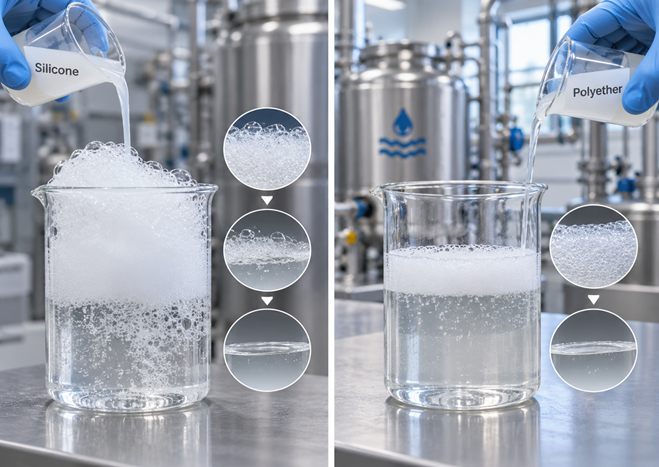
Different industries require different foam-control solutions. The ideal defoamer should match the chemical environment, processing conditions, and final product requirements.
Common application considerations include:
Detergent and cleaning products: The defoamer should control foam while maintaining cleaning performance and compatibility with surfactants.
Industrial coatings: The material should reduce bubbles and surface defects without affecting coating appearance.
Chemical processing: The defoamer should remain stable under specific temperature, pH, and mechanical conditions.
Wastewater treatment: Long-lasting foam suppression and environmental compatibility are important factors.
When selecting foam-control materials, manufacturers should also understand the relationship between different chemical ingredients. For example, reviewing suitable surfactant products can help companies better evaluate how surfactants influence foam generation and how defoamers should be incorporated into formulations.
NJCHM supports customers with professional chemical solutions and helps manufacturers select suitable materials based on their application requirements.
The performance of a defoamer depends not only on its chemical type but also on the operating environment.
Temperature changes can influence viscosity, dispersion ability, and foam stability. High-temperature manufacturing processes may require defoamers with stronger thermal resistance to maintain consistent performance.
pH conditions also affect foam-control efficiency. Different formulations may require materials that remain stable in acidic, neutral, or alkaline environments.
Mechanical factors such as high-speed mixing, pumping, and agitation can introduce additional air into the system and create more stable foam structures.
For this reason, laboratory testing and production trials are often necessary before large-scale application. A suitable antifoaming agent should effectively reduce foam while maintaining formulation stability and product quality.
Before purchasing large quantities, manufacturers should conduct application testing to confirm whether a defoamer meets their production requirements.
A typical evaluation process includes:
Testing foam reduction efficiency
Determining suitable dosage levels
Checking compatibility with existing ingredients
Evaluating long-term stability
Supplier qualification is also an important part of chemical procurement. A reliable supplier should provide consistent product quality, technical documentation, and professional application support.
When selecting a chemical partner, buyers should evaluate production capability, quality control systems, technical communication, and supply stability.
For companies developing new formulations, understanding the difference between ingredients is also valuable. For example, learning about surfactant vs emulsifier helps formulators better understand ingredient functions and improve formulation design.
NJCHM provides professional chemical solutions and supports global customers with reliable supply capabilities and technical assistance.
Industrial antifoaming agents are used to reduce or prevent unwanted foam during manufacturing processes.
Not always. Their performance depends on formulation compatibility, operating conditions, and production requirements.
The dosage depends on the foam level, formulation system, and desired performance. Testing is recommended before full production.
Yes. An incompatible defoamer may influence appearance, stability, or final product performance.
Experienced suppliers can provide consistent quality, technical support, and application recommendations.
Surfactants can stabilize foam structures, so defoamer selection should consider surfactant type and concentration.
Choosing the right industrial antifoaming agent requires careful evaluation of application conditions, formulation characteristics, and production requirements. Silicone and polyether defoamers provide different advantages depending on the industrial environment. By understanding foam behavior, testing performance, and selecting suitable chemical partners, manufacturers can achieve more efficient foam control. NJCHM provides professional chemical solutions to support customers with reliable materials, technical expertise, and stable supply capabilities.