Nanjing Chemical Material Corp.

Choosing the right surfactant grade is essential for manufacturers developing detergents, personal care products, and industrial cleaning formulations. Among various anionic surfactants, Alpha Olefin Sulfonate (AOS) has become a popular choice because of its excellent detergency, rich foam performance, mildness, and compatibility with different formulation systems.
However, when purchasing AOS raw materials, manufacturers often need to decide between powder and liquid grades. The differences between AOS powder and AOS-35 liquid influence not only formulation design but also transportation, storage, production efficiency, and overall manufacturing costs.
Nanjing Chemical Material Co., Ltd. (NJCHM) provides professional surfactant solutions for global customers, helping detergent and personal care manufacturers select suitable raw materials according to their application requirements.
Understanding the differences between these two AOS formats can help formulators make better purchasing decisions and optimize production processes.
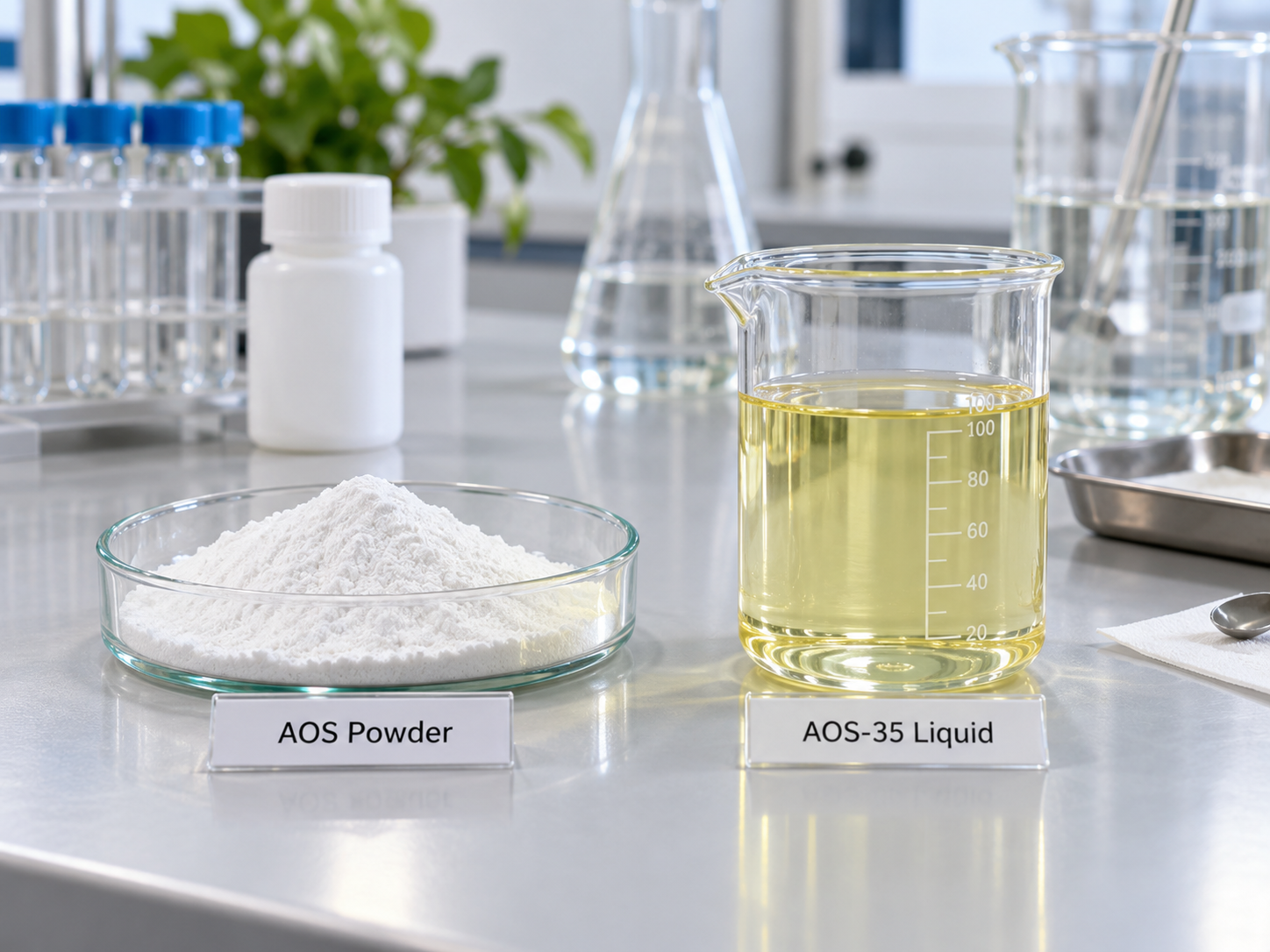
Alpha Olefin Sulfonate is an anionic surfactant produced through the sulfonation of alpha olefin. It is widely used in laundry detergents, personal care products, household cleaners, and industrial formulations.
Although AOS powder and AOS-35 liquid belong to the same surfactant family, their physical forms create different advantages.
AOS powder is a dry surfactant product with high active content. It is often selected for powder detergent formulations and applications where manufacturers need lower moisture content and efficient transportation.
AOS-35 liquid is a liquid surfactant solution containing approximately 35% active matter. Compared with powder products, it offers easier pumping, mixing, and handling during liquid formulation processes.
When evaluating different grades, manufacturers should consider not only product form but also technical parameters. Reviewing detailed alpha olefin sulfonate specification information helps buyers understand active content, performance characteristics, and suitability for different applications.
The selection between powder and liquid AOS depends largely on production requirements and application scenarios.
| Feature | AOS Powder | AOS-35 Liquid |
| Physical form | Solid powder | Liquid solution |
| Active matter | Higher concentration | Around 35% active content |
| Storage | Easier dry storage | Requires liquid storage conditions |
| Transportation | Lower water content | Requires liquid packaging |
| Processing | Suitable for dry mixing | Convenient for liquid production |
| Common applications | Powder detergents, solid cleaners | Liquid detergents, shampoos, cleaners |
For manufacturers producing powdered detergents, AOS powder can simplify formulation because it integrates easily with other dry ingredients.
For liquid detergent producers, AOS-35 liquid can improve processing efficiency because it can be directly added into water-based systems.
Different applications require different surfactant characteristics. Therefore, choosing the correct grade is an important step in maintaining product quality and production efficiency.
Different industries have different expectations for surfactant performance.
AOS powder is commonly used in:
Powder laundry detergents
Solid cleaning products
Dry blending formulations
Applications requiring high active surfactant content
AOS-35 liquid is often preferred for:
Liquid laundry detergents
Dishwashing products
Shampoo formulations
Personal care cleaning products
For manufacturers researching AOS powder applications, powder surfactants can provide advantages in formulations where moisture control and transportation efficiency are important.
Meanwhile, liquid AOS grades are often selected when manufacturers prioritize production convenience and faster incorporation into formulations.
The best choice depends on factors such as product type, manufacturing equipment, target performance, and supply chain requirements.
Active matter is one of the most important factors when comparing surfactant products.
A higher active concentration can reduce the amount of raw material required to achieve the desired cleaning performance. However, manufacturers should also evaluate processing convenience and logistics costs.
The overall impact includes:
Raw material dosage
Production efficiency
Packaging requirements
Storage conditions
Transportation expenses
For example, powder surfactants generally contain less water, which may provide advantages during long-distance transportation.
Liquid surfactants, on the other hand, can reduce preparation steps during manufacturing because they are easier to transfer and mix.
When selecting an AOS chemical supplier, manufacturers should consider both product performance and supply chain efficiency rather than focusing only on unit price.
Reliable surfactant performance depends on consistent quality and proper supplier selection.
Before purchasing AOS products, manufacturers should evaluate:
Active matter consistency
Product testing procedures
Packaging options
Storage requirements
Supplier production capability
A qualified supplier should provide technical documentation, stable product quality, and professional support throughout the purchasing process.
NJCHM focuses on providing reliable chemical materials and supporting global customers with consistent supply capability. Through professional quality management, the company helps manufacturers maintain stable production performance.
For companies purchasing surfactants in bulk quantities, supplier reliability is just as important as product specifications.
Alpha Olefin Sulfonate is widely used in detergents, personal care products, and industrial cleaning formulations.
Neither product is universally better. The suitable choice depends on formulation requirements and production processes.
AOS powder is often selected because of its high active content, easy storage, and suitability for dry formulations.
AOS-35 liquid is convenient for mixing and processing in water-based formulations.
Buyers should review specifications, active content, quality standards, and supplier capability.
Companies should evaluate product consistency, technical support, manufacturing capability, and supply stability.
Choosing between AOS powder and AOS-35 liquid requires careful consideration of formulation needs, production processes, and supply chain requirements. AOS powder provides advantages for dry formulations and efficient transportation, while AOS-35 liquid offers convenience for liquid product manufacturing. NJCHM supplies reliable Alpha Olefin Sulfonate solutions and supports global customers with professional chemical expertise, stable quality, and customized surfactant solutions.